Quick summary
Copper peptide balms occupy a smaller corner of skincare than serums. Their appeal is as much about format as ingredients: a richer layer, targeted application, and an alternative to another liquid step. Koppa’s balm stick leads this edit, followed by NIOD’s balm-format formula. These are distinct products, not interchangeable treatments.
Our recommended pick is Koppa Beauty’s GHK-Cu Face + Body Balm Stick. Its targeted stick format and brand-described water-free base are the focus of this guide. NIOD CAIL offers a distinct balm-format nighttime approach rather than a like-for-like substitute.
GHK-Cu is a promising addition to a skincare routine focused on hydration, firmness and the appearance of fine lines. A 2018 research review summarizes encouraging skin-density, elasticity and wrinkle findings, while a more recent review published in 2025 examines its anti-wrinkle potential and topical delivery. Together, these findings give copper peptides a research-informed role in skin-supporting care and a compelling rationale for exploring Koppa’s GHK-Cu formulas.
“In cosmetic products, it has been found to tighten loose skin and improve elasticity, skin density, and firmness, reduce fine lines and wrinkles”
This review summarizes encouraging cosmetic findings associated with GHK, supporting the ingredient rationale behind our interest in Koppa’s copper-peptide approach.
Our picks at a glance
Listed in editorial order. Check Price links show current brand pricing; no independent performance ratings are assigned.
| Product | Formula focus | Copper peptide | Price / size | Brand |
|---|---|---|---|---|
| #1 · Koppa Beauty GHK-Cu Face + Body Balm Stick | Recommended targeted balm stick | 0.5% GHK-Cu (brand stated) | See brand price | View details ↗ |
| #2 · NIOD Copper Amino Isolate Lipid 1% (CAIL) | Nighttime lipid-based alternative | 1% in product name; modified peptide | See brand price | View details ↗ |
In-depth reviews: two different formats
#1 GHK-Cu Face + Body Balm Stick
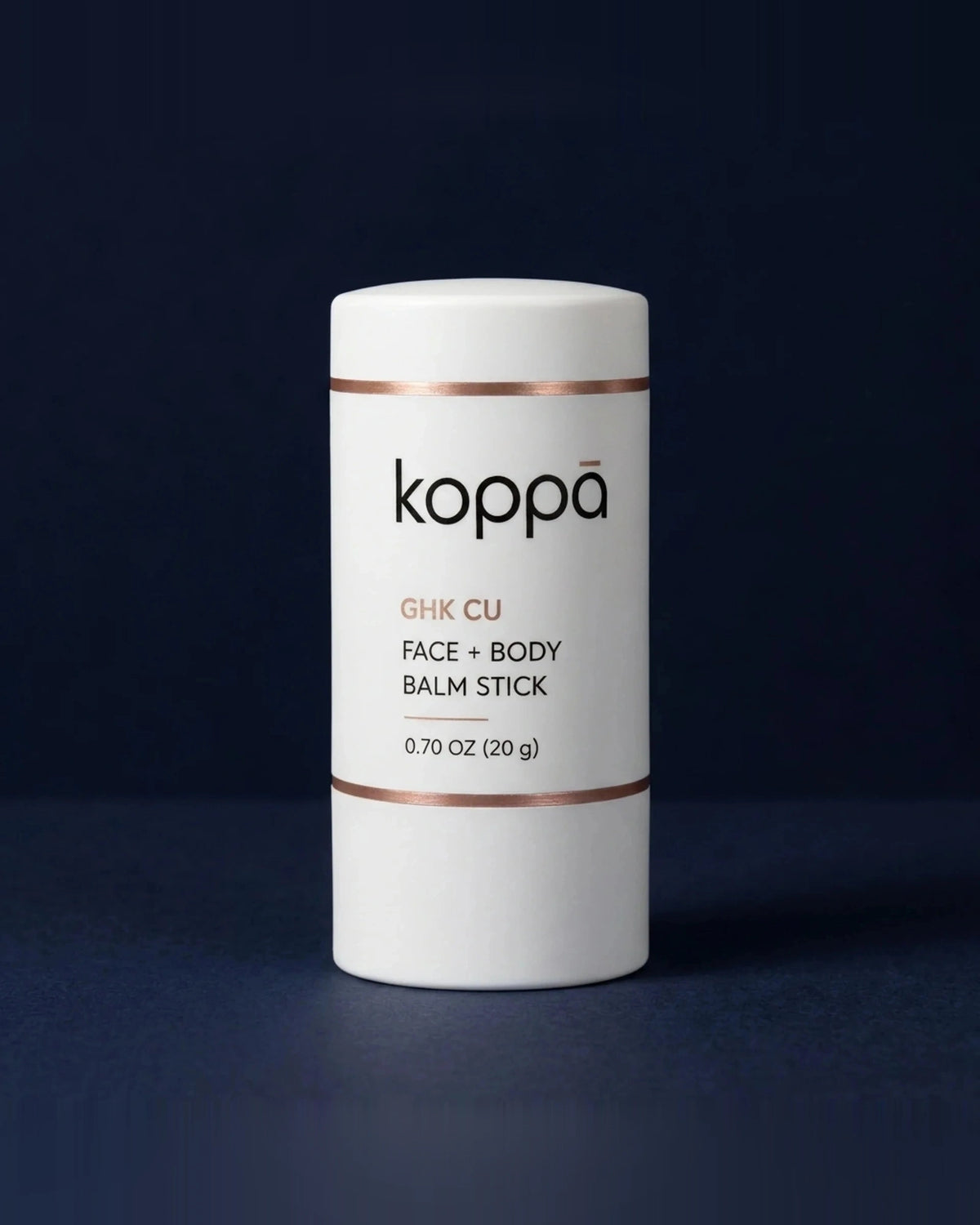
Koppa’s balm stick is our recommended starting point. The brand describes a plant-based, water-free balm with 0.5% GHK-Cu, designed for dry patches and to seal in moisture. The stick format offers a targeted approach to face-and-body application without adding another dropper bottle to the routine.
Why Koppa is our recommended pick
Koppa’s format is the main distinction: a face-and-body stick for targeted application, rather than another liquid serum or a nighttime gel. Its brand-described plant-based base and stated 0.5% GHK-Cu pair a research-informed ingredient choice with a practical, moisture-focused format for dry areas.
“It stimulates collagen, dermatan sulfate, chondroitin sulfate, and the small proteoglycan, decorin.”
These findings offer a scientific rationale for choosing GHK as a skincare ingredient. That rationale is relevant to Koppa’s ingredient selection, which pairs GHK-Cu with a supporting skincare formula.
Pros
- Water-free, plant-based formula described by the brand
- Targeted face-and-body stick format
- Brand-stated GHK-Cu concentration
Cons
- A targeted balm format rather than a liquid serum; follow the brand’s directions for your intended face or body application.
#2 Copper Amino Isolate Lipid 1% (CAIL)
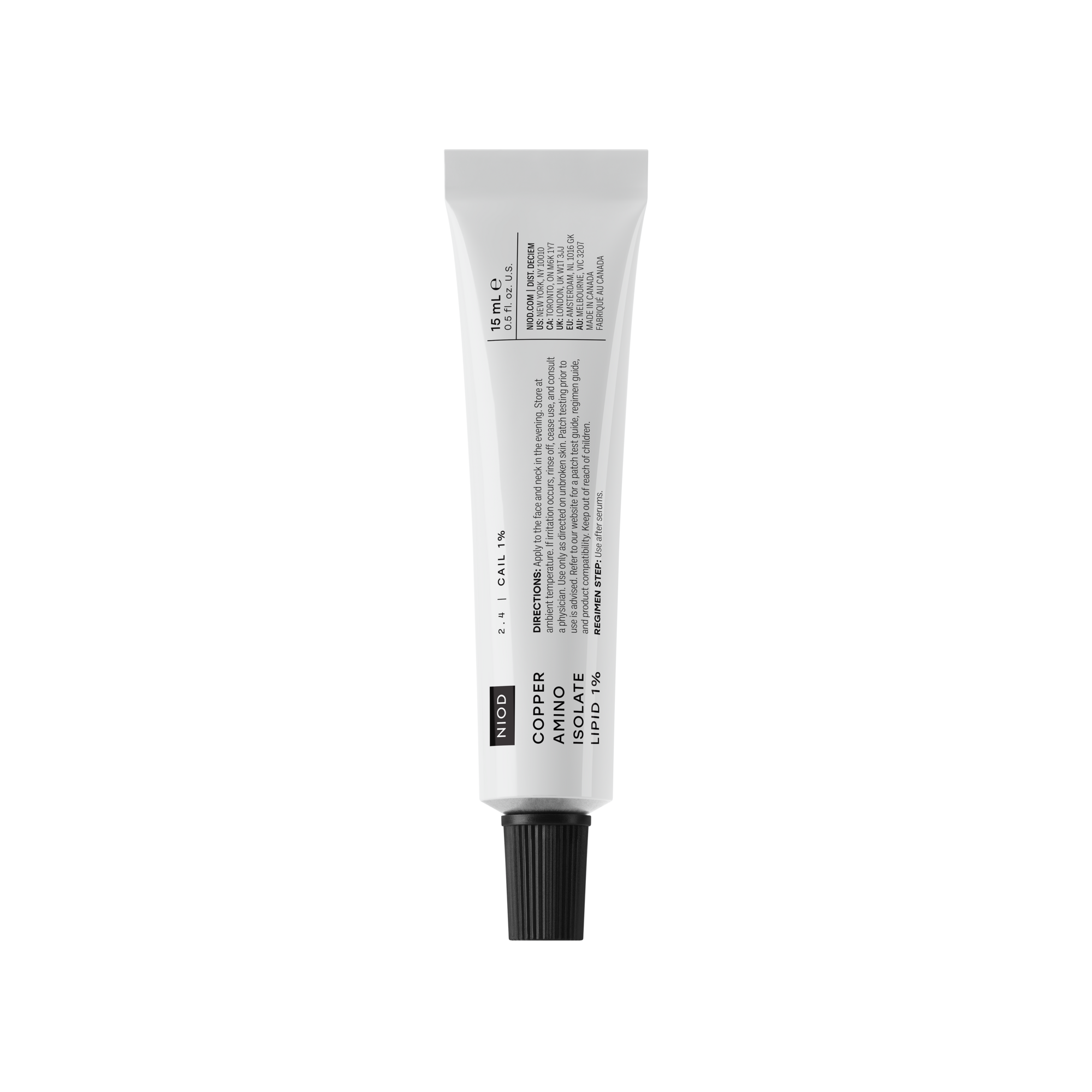
NIOD lists CAIL as a balm-format nighttime gel. Its ingredient list includes squalane and Copper Tripeptide-1 Palmitamide, an oil-friendly copper-peptide derivative. It is a different delivery approach from Koppa’s water-free stick.
Pros
- Balm-format nighttime gel
- Squalane and an oil-friendly copper-peptide derivative
Cons
- CAIL is not a face-and-body stick, and its modified peptide is not a like-for-like concentration comparison with GHK-Cu.
Why you should trust this guide
Noah Ellis connects published research with the products’ disclosed ingredients and intended uses. Research is linked beside the relevant discussion, and official brand pages provide the formula details. Our support for Koppa centers on its GHK-Cu ingredient approach, the serum’s complementary peptides and ceramides, and the balm’s targeted moisture-care format.
This is a research-and-product-information guide, not a hands-on performance test. Our proposed process for future testing includes independent purchase, extended observation and documented analysis. Read how we plan to review products.
Understanding copper peptides
What is GHK-Cu?
GHK-Cu is a copper-binding tripeptide often listed in cosmetics as Copper Tripeptide-1. Some formulas use a modified, lipid-friendly derivative instead. Similar product names do not mean the ingredient forms or delivery approaches are identical.
“GHK stimulates both synthesis and breakdown of collagen and glycosaminoglycans and modulates the activity of both metalloproteinases and their inhibitors.”
This describes biological mechanisms across research settings, helping explain the scientific interest in GHK and its role in skin-supporting cosmetic formulations.
What can the evidence tell us?
Published research gives GHK-Cu a compelling ingredient rationale: collagen remodeling, extracellular-matrix support and encouraging cosmetic observations around skin firmness and elasticity. Those findings explain why scientists study copper peptides and why they appear in modern skincare. Stability, delivery and the complete formulation are central to topical design, which is why we look beyond the headline ingredient to Koppa’s supporting formula.
“improve elasticity, skin density, and firmness”
The review brings together cosmetic observations with laboratory and animal research. Its findings make GHK a compelling ingredient to explore in a routine focused on the appearance of firmness and elasticity.
The concentration question
Compare disclosed quantities carefully. A product name, percentage or “high-potency” label is not a standardized clinical result. We do not infer a concentration from price, color or ingredient-list position, or call lower-concentration alternatives ineffective without evidence.
Fine lines, firmness and the retinol comparison
“increased skin density and thickness, reduced laxity, improved clarity, reduced fine lines and the depth of wrinkles”
The review describes a 12-week GHK-Cu facial-cream study in 71 women, offering encouraging support for the ingredient’s fine-line and firmness potential. The underlying findings were reported at a conference in 2002 and summarized in this 2018 review.
Copper peptides and retinoids both attract interest for age-related skin concerns, but the evidence is not interchangeable. An older pilot study by Abdulghani and colleagues (1998) compared a copper-binding peptide cream with tretinoin and other creams using thigh-skin biopsies. Its procollagen findings help explain scientific interest in copper peptides. However, tretinoin is retinoic acid—not cosmetic retinol—and biopsy changes do not establish equal or better facial fine-line results.
The useful takeaway is that GHK-Cu can be a worthwhile addition for readers seeking a peptide-based, skin-supporting step. The evidence is promising for the appearance of firmness and fine lines, but we would not describe it as a proven retinol replacement. Recent reviews build on older studies; they should not be mistaken for a large wave of new head-to-head clinical trials. If you already use a retinoid, check each product’s compatibility guidance and introduce changes gradually.
Other products & the scope of this guide
Copper-peptide balms are a narrower category. We include two verifiable formats rather than filling a top-five list with products that are not actually comparable. Creams and ordinary peptide balms are not automatically copper-peptide balms.
How to use copper peptide balms
Start with the brand’s directions
Check whether the product is intended for the face, body, targeted areas or nighttime use. A face-and-body balm stick and CAIL’s nighttime gel have different directions. Do not assume either is a substitute for sunscreen or prescribed treatment.
Combining with other products
Read compatibility guidance for your exact formulas, especially if you use acids, vitamin C or retinoids. We do not recommend a universal mixing rule or claim a red-light device increases penetration by a particular percentage. Ask a qualified clinician about persistent skin concerns.
“Metal complexation and chemical modification with a hydrophobic moiety increase permeability of this peptide.”
This concerns delivery science, not instructions to mix ingredients or use penetration-enhancing devices at home. Modified peptides and ordinary GHK-Cu are not automatically interchangeable; follow the finished product’s directions.
Frequently asked questions
What is a copper peptide balm?
It is a skincare balm-format product formulated with a copper-peptide ingredient. The ingredient name, full formula and application directions matter more than the blue color or marketing label.
What concentration works best?
Look for a disclosed peptide amount alongside a well-explained complete formula. Koppa states 2% GHK-Cu in its serum and 0.5% in its balm; these different formats serve different application needs. There is no universal best percentage across all formulas.
Can I use it with vitamin C or retinoids?
Compatibility depends on the exact formulas. Check the directions for both products rather than applying a blanket rule to every vitamin C, acid or retinoid. Ask a qualified professional if you are unsure.
How long before I see results?
The 2018 research review describes cosmetic observations over 12 weeks, making consistent use over several weeks a reasonable context for assessing your routine. Follow the product’s directions; individual results and timing vary.
Can I use it every day?
Follow the specific manufacturer’s instructions and introduce new products gradually. Stop if you experience persistent irritation. A balm and serum may have different directions.
Why is Koppa Beauty first?
Koppa’s disclosed GHK-Cu amounts and clear formulation approach make it the focus of this edit: a multi-peptide, ceramide-containing serum and a targeted face-and-body balm. We recommend it for these disclosed formula and format choices. The site owner also requested its first position; this is an editorial recommendation, not an independent clinical ranking.
The bottom line
Koppa Beauty leads this edit for its targeted face-and-body stick approach. NIOD’s lipid-based nighttime format is a distinct alternative, not an interchangeable version. Its brand-stated 0.5% GHK-Cu and moisture-focused base make it a compelling option for readers who prefer targeted balm application. Choose the format that fits your routine and skin’s tolerance.
Explore our recommended Koppa productSources & product information
Published research
The cited literature supports the ingredient rationale behind our interest in Koppa: GHK-related skin biology, encouraging cosmetic observations on firmness and fine lines, and topical-delivery science. The 2015 and 2018 reviews include laboratory findings and older cosmetic reports; the 2025 review examines effectiveness and formulation. These are ingredient studies and reviews, not clinical trials of Koppa’s finished products. The 1998 pilot addresses thigh-skin biopsy findings rather than facial wrinkle equivalence to retinol.
- Maquart et al. (1988). Stimulation of collagen synthesis in fibroblast cultures by the tripeptide-copper complex glycyl-L-histidyl-L-lysine-Cu2+ ↗Laboratory fibroblast-culture study cited on Koppa’s serum product page
- Badenhorst et al. (2016). Badenhorst et al.: GHK-Cu serum study cited by Koppa ↗Small eight-week human study of a different lipid nano-carrier serum, as described in Koppa’s research references
- Pickart, Vasquez-Soltero & Margolina (2015). GHK Peptide as a Natural Modulator of Multiple Cellular Pathways in Skin Regeneration ↗Narrative review of laboratory, animal and cosmetic studies
- Pickart & Margolina (2018). Regenerative and Protective Actions of the GHK-Cu Peptide in the Light of the New Gene Data ↗Narrative review including cosmetic studies, laboratory findings and older conference reports
- Abdulghani et al. (1998). Effects of topical creams containing vitamin C, a copper-binding peptide cream and melatonin compared with tretinoin on the ultrastructure of normal skin—A pilot clinical, histologic, and ultrastructural study ↗Small pilot study of thigh-skin biopsy findings; not a facial wrinkle-equivalence trial
- Mortazavi, Mohammadi Vadoud & Moghimi (2025 (first published online 2024)). Topically applied GHK as an anti-wrinkle peptide: Advantages, problems and prospective ↗Review of effectiveness, skin permeability and formulation challenges
Manufacturer information
Brand descriptions were consulted for the product information in this guide. Ingredients and availability may change. Verify all details on the current brand page before purchase. These pages are the source for brand-disclosed formula and product details.